
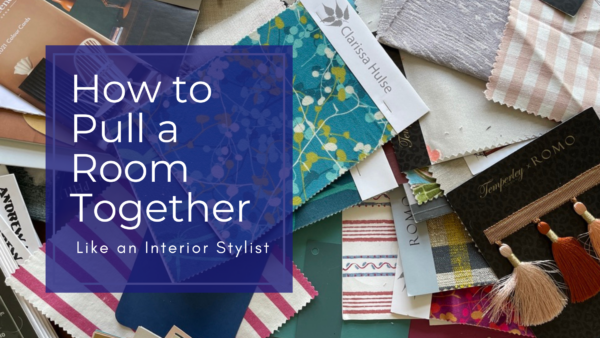
Why mood boards make styling so much easier
A few years ago I was at a press event where one corner of the room had been transformed into a space for yoga and meditation workshops.
As soon as I walked in, I recognised the paint colour.
“Is that Tranquil Dawn?” I asked the PR.
It was.
You might know Tranquil Dawn – it was Dulux’s Colour of the Year and had been chosen because it reflected our “growing need for calm, wellbeing and sanctuary at home“. Standing in that room, I completely got it.
The room felt calm before anyone had even rolled out a yoga mat.
If the walls had been painted brilliant white, it would have felt clinical. If they’d been blue, I think it would have felt too cold, but this soft, muted green completely changed how the room felt.
I’ve thought about that moment many times since because, for me, it perfectly sums up what interior styling is all about.
It isn’t really about colour, wallpaper or furniture. It’s about how a space makes you feel. That’s my favourite bit.
We often start with the things we love
One thing I’ve noticed over the years is that people rarely struggle to put a room together because they’ve chosen the wrong things. More often than not, they’ve chosen lots of lovely things – they just don’t know how to pull them together into one cohesive scheme.
They’ve found a wallpaper they absolutely love, a fabric they’ve become obsessed with or a sofa they saved on Pinterest months ago. Finding beautiful things is the easy bit. Most of us are experts at that. The challenge is knowing how to make those pieces work together so they feel as though they belong in the same room.
When you’re looking at individual samples on a table, it can be incredibly difficult to picture how they’ll work once the wallpaper covers four walls, the curtains are hanging, the rug is down and the furniture is in place. You’re making lots of decisions without ever seeing the whole picture. That’s usually when confidence starts to wobble.
This is why I always create a mood board
People often assume a mood board is just somewhere to collect inspiration. I’ve never really seen it like that. For me, it’s how I communicate an idea. If I’m presenting a scheme to a client, I don’t just want them to see what I’ve chosen. I want them to understand why I’ve chosen it. A wallpaper might take up a large area of the mood board because that’s exactly what it’s going to do in the room. Paint colours become smaller swatches because they’re a smaller part of the room – we don’t want it dominating it. Then I’ll add trims, furniture, lighting, artwork and accessories until the whole room starts to make sense.
At that point, it stops being a collection of lovely things and starts feeling like an intentional room.
My favourite part of teaching styling
This is probably my favourite part.
Everyone starts in exactly the same place. They’re excited about beautiful fabrics, gorgeous wallpapers, interesting lighting and furniture. So am I. That’s one of the joys of interiors. Then I ask them to talk me through their mood board. Why this fabric? Why that wallpaper? What feeling are you trying to create?
It’s amazing how often the answers reveal something they hadn’t noticed themselves. Someone might tell me they’re hoping the room will feel calm and cosy, but they’ve chosen six accent colours that are all competing for attention. Or they’ve fallen in love with three bold patterns that all work beautifully on their own but don’t really give each other any room to breathe. I don’t point these things out because I’m trying to catch people out. I ask questions because I want them to see it for themselves. And they usually do.
That’s the point where everything changes. They stop looking at individual fabrics or pieces of furniture and start looking at the room as a whole. Instead of asking, “Do I like this?” they start asking, “Does this help create the room I want?”
It’s a small shift, but it’s the point where people start trusting their own decisions.
Good styling is about editing as much as adding
One of the biggest misconceptions about styling is that it’s all about adding more.
Sometimes it is. Sometimes a room needs another layer of texture, a taller lamp or a larger piece of artwork. But just as often it’s about taking something away. One colour too many, one pattern, or even one piece of furniture that makes the room feel cluttered instead of comfortable. Knowing when to stop is every bit as important as knowing what to add, and that’s much easier to judge when you can see everything together instead of making one decision at a time.
Seeing the bigger picture
I think that’s why I still love mood boards after all these years. It’s not because they look good, although they usually do, or because they’re fun to put together, although they definitely are, but because they help people see something they couldn’t quite see before.
Once you stop thinking about individual products and start thinking about atmosphere, balance and how you want a room to feel, the decisions become much easier.
For me, that’s what interior styling has always been about.
Not filling a room with beautiful things, but creating somewhere people genuinely want to spend time.
Want to learn how to create your own mood boards?
If you’ve ever looked at a beautifully styled room and wondered how all the different elements came together so effortlessly, I’d love to show you.
This September I’m launching a new mood board workshop, where I’ll take you through the process I use to pull a scheme together, helping you make confident decisions and create rooms that feel cohesive from the very beginning – whether you’re styling your home or a photoshoot.
If you’d like to be the first to hear when booking opens, pop your details in the form below, and I’ll send you all the details as soon as it’s live.