
How Interior Stylists Choose Tiles?
I don’t know if it’s because I’m planning to do my kitchen at the end of the year, but press releases about gorgeous new tiles seem to be filling my inbox at the moment. It’s a bit like when you buy a yellow car, and suddenly all you can see are yellow cars.
There are SO many beautiful designs around. The problem is, choosing tiles for your own home can feel like a big deal. They’re expensive for starters. And it’s not just the tiles. There’s the adhesive, the grout, the tiler and then the general disruption of having a kitchen or bathroom out of action while they’re being fitted. Once they’re on the walls, you’re going to be looking at them for a good few years too.
No pressure then!
I’ve been an interior stylist for over 25 years, and I’ve chosen tiles for countless photoshoots over that time. Choosing for a shoot is obviously very different to choosing for your own home, but the thought process behind it is quite similar. The first thing I think about isn’t really the tile at all. It’s how I want the room to feel.
How do you want your room to feel?
When I’m looking at shots of tiles, it’s usually the styling of the room that makes me stop the scroll. I want to see something a bit different.
If you’re a really colourful person, you probably won’t love a plain white metro tile. Maybe you do. But don’t choose it just because it feels like the sensible option and it’s what everyone else seems to have or worse – because it will add to the value of your house when you sell. Unless you’re planning to sell in the next year or so, don’t buy those.
Maybe you don’t want your kitchen to feel sleek and crisp. Maybe you want it to feel warm and cosy. As I write this, it’s absolutely tipping it down outside, so admittedly I’m very much in the mood for cosy, but I don’t think this is just an autumn thing. We want to feel at home in our homes.
Tiles are essentially a cold, hard surface, but the colour, pattern, texture and shape you choose can make them feel anything but cold. For me, that’s where I’d start. Not with what’s trending. How you actually want to feel when you walk into that room?
I want colour to cocoon me
I love pattern. I love clashing patterns, and I really love colour. I’m always drawn to blues and greens. I love a touch of bright pink too. I like red, but I can’t really live with it. I find it quite an angry colour in my own home. I don’t want colour that’s going to stimulate me. I want colour that’s going to cocoon me. And I’m going to use a phrase I hate here because, annoyingly, it describes exactly what I mean.
I want my heart to sing when I walk into a room.
There. I said it.
I don’t want my home to be all crisp, white and perfect. I want it to feel warm and inviting and interesting. And I think that’s important when you’re choosing something as permanent as tiles.
It’s very easy to get frightened of making the wrong decision and end up choosing the safest option instead.
Let me introduce you to our dinosaur bathroom
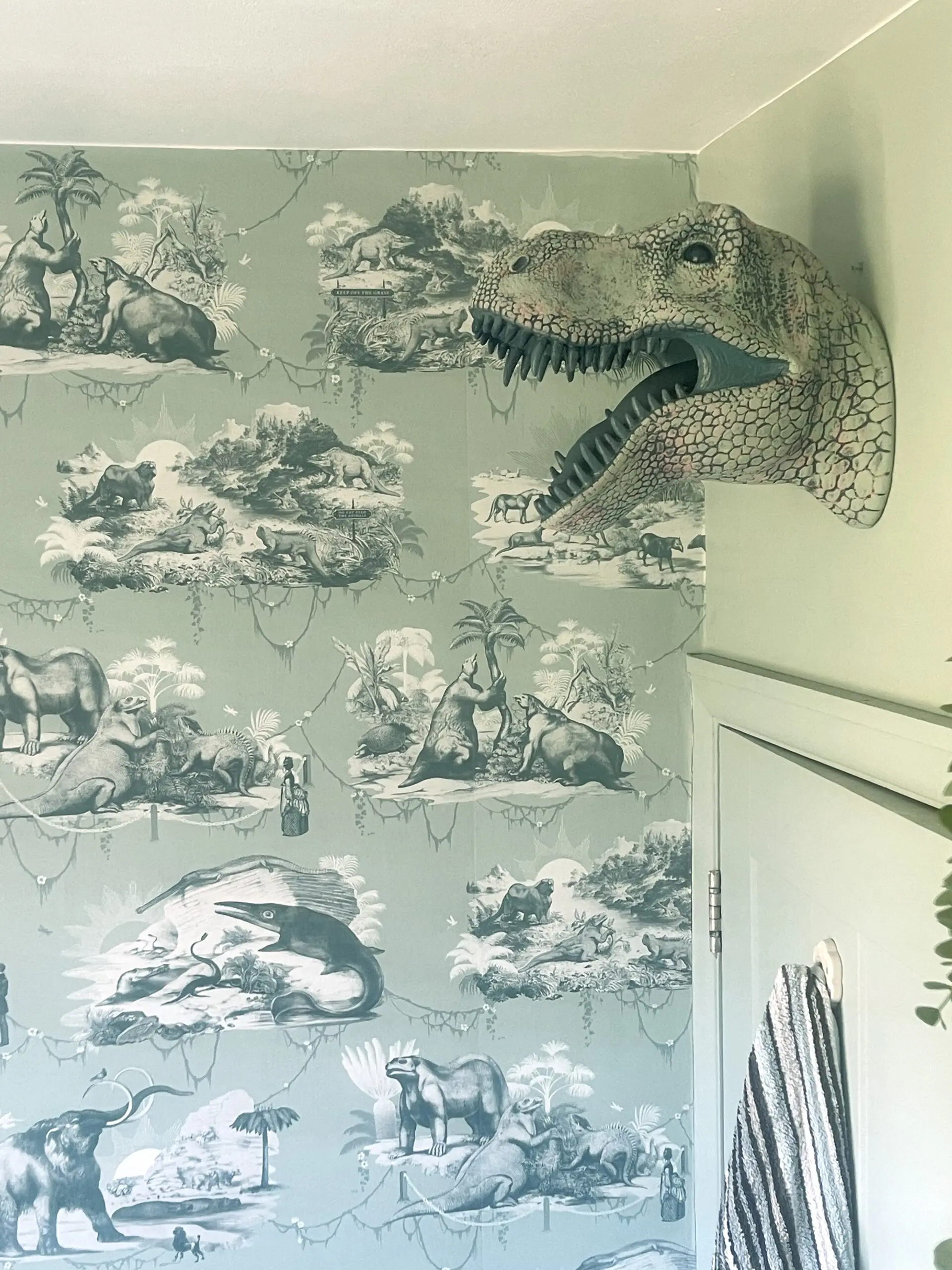
Our family bathroom is known as the “dinosaur bathroom”.
This is because it has a fabulous Divine Savages dinosaur wallpaper in it, that inspired the whole design. I should probably add that creating this bathroom nearly ended in divorce. My husband and I decided that learning to plaster, tile AND fit a bathroom ourselves would be a good idea.
It was not.
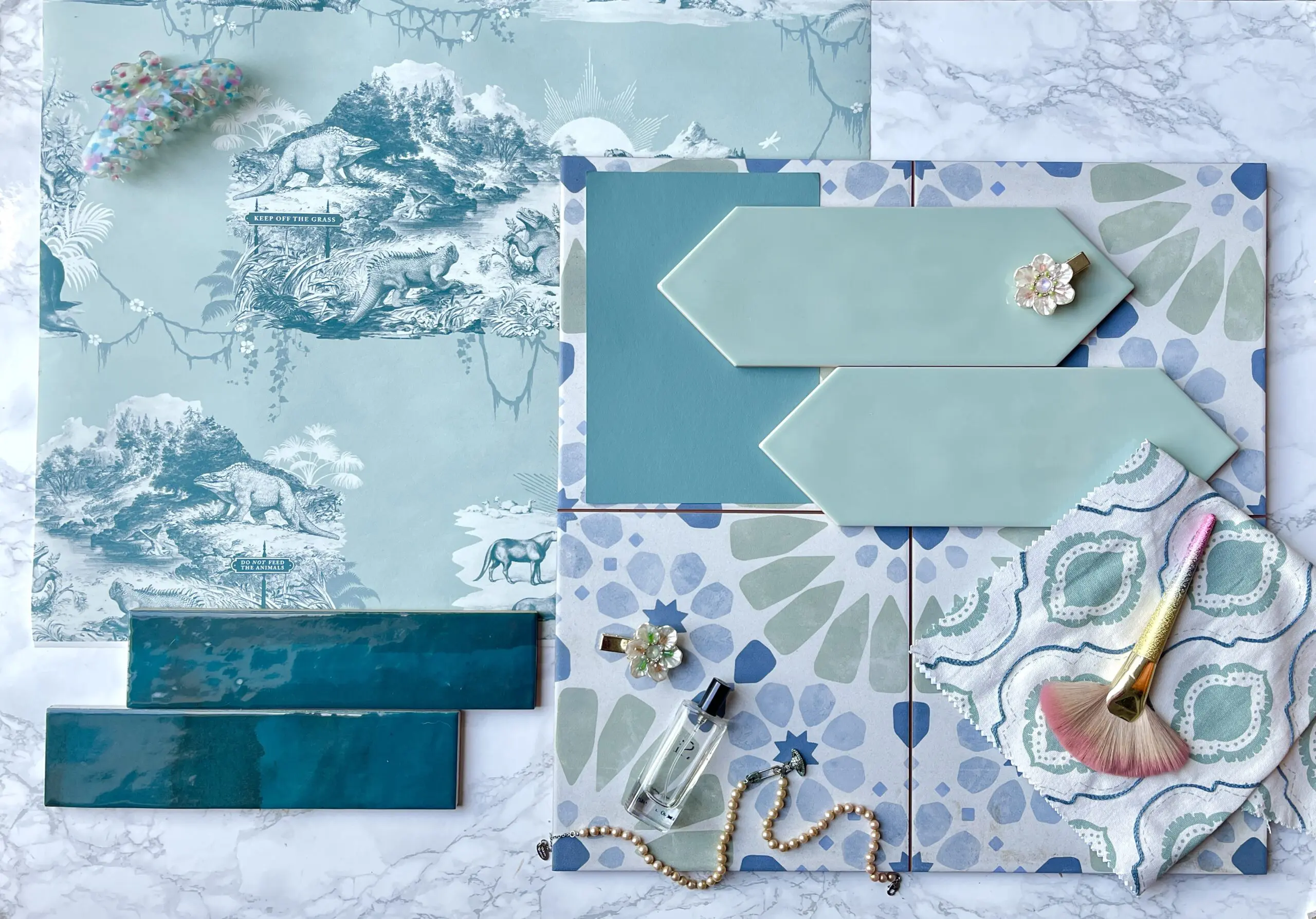
We will never do that again. But I absolutely love the finished room. We used three different types of tiles, because one was never going to be enough. There are large square floor tiles – that are grooved so they look like four smaller patterned tiles. Then we used long hexagonal, mint green tiles around the bath and a really deep, mottled, teal, skinny rectangle design behind the basin.
It sounds like a lot when I list it like that.
But it works.
The mint and teal colours both appear in the patterned floor tile and the wallpaper, so the colours became the thread that pulled everything together.
The wallpaper came first, then the patterned floor, and from those two elements I could make decisions about everything else – the wall tiles, splashback tiles and paint colours.
And I still love walking into that bathroom. It’s also the only bathroom in our house with a bath, and I LOVE a bath. Preferably an Epsom salt bath. In fact, if one of my kids, family or friends tells me something is wrong, there’s a fairly good chance my advice will be, “Go and have an Epsom salt bath.” Everything feels better after a bath. And I think that’s part of why this room matters to me. It’s not just that I like the tiles and patterns. I like how I feel when I’m in there.
You don’t have to use the same tiles everywhere
This is probably one of my biggest pieces of advice.
You can mix them up. Different sizes. Different shapes. Different colours. Different textures.
Think about decorating a bathroom in the same way you might think about decorating a living room. You wouldn’t automatically put exactly the same surface, colour or texture on the floor, walls and fireplace in a living room, would you?
You’d layer things. You can do the same with tiles. You can use larger tiles on the floor, something smaller behind a basin, long thin tiles on a wall and something completely different around the bath. They just need something that makes them feel as though they belong together. In our bathroom, that was colour.
And yes, you CAN use big tiles in a small bathroom
There’s a strange idea that small bathrooms need small tiles.
They really don’t.
In fact, lots of small tiles and lots of grout lines can sometimes make a small room feel far too fussy. A larger tile can work brilliantly because you have fewer grout lines and therefore a much calmer-looking surface.
Obviously, there isn’t one rule that works for every room. But don’t discount a tile you love just because somebody told you it’s “too big” for a small bathroom.
Play with scale.
Here’s an interior stylist’s tile trick
I’ll let you into a little photoshoot secret.
Sometimes we fake the tiles. Don’t tell anyone.
If we find a location that’s almost perfect for a shoot but it doesn’t have the surface we need, we can make one.
I’ve hot-glued tiles onto a piece of wood before and then positioned it behind a unit or table so that, as far as the camera is concerned, we’ve got a beautifully tiled wall. I’ve even worked on a shoot recently where the photographer brought a tiled backdrop from their own home in their car. She carried it upstairs under her arm ready to shoot!
Unless you’re an interior stylist or photographer, you’d probably never know. Obviously, this doesn’t help much when you’re actually tiling your bathroom for real because I wouldn’t recommend hot-gluing your tiles to a bit of MDF and hoping for the best, but it does show something about the way interior stylists think. We’re looking at the shots. What does the colour do for the product? What does this pattern add? Is the scale right? Does it work with all the other props? And most importantly, does it tell the story we’re trying to tell?
When I’m working for a brand, I’m imagining their customer walking into that room and thinking, “I want my home to feel like this.” When you’re decorating your own home, you’re both the stylist and the customer.
I nearly always choose matt tiles
I’ve noticed a lot more glossy, heavily textured tiles recently, and some of them are absolutely gorgeous. But I’m still naturally drawn to matt. I think this goes all the way back to studying product design at university.
Whenever we designed something we made models and painted them; we were taught that if you painted something in a glossy finish, every single tiny imperfection in your model-making would show. Paint it matt, and you could get away with a multitude of sins. Maybe that’s why I’ve always been drawn to matt finishes. It could be completely subconscious. That doesn’t mean matt is better. It’s just what I’m drawn to.
And that’s another thing worth thinking about. You don’t necessarily need to justify why you love something. Sometimes you just do.
Pleeeeaaaase find yourself a brilliant tiler
Now for the less glamorous bit.
About 15 years ago, we had some tiles fitted by a tiler who’d worked for us before and had done a really good job. This time he didn’t.
The tiles should have been staggered, like brickwork, but he stacked them directly on top of each other. The wall also turned out not to be quite as straight as it looked, and the way the tiles were laid made it really obvious. I cried for days. We’d spent a lot of money on it, and I was absolutely heartbroken. I don’t think I’ve ever quite got over it.
Which sounds ridiculous because we’re talking about tiles, but that’s exactly my point. When you’ve saved up, chosen something you love and gone through all the disruption of having the work done, getting it wrong is horrible.
I now have one tiler I trust implicitly. Richie. I’ll wait months for Richie to be available because he tiles beautifully. I’ll give you his number if you like?
A really good tiler is worth their weight in gold. Talk to them before they start. Don’t assume that because the layout is obvious in your head, it’s obvious to everyone else. Decide where tiles start, where cuts will fall, how they’re going to be laid and what colour grout and sealant you want. Then check it again.
Don’t choose tiles from a tiny shot on your phone
Samples. Samples. Samples.
Get them into the actual room. Put them next to your flooring, worktop, paint colours, wallpaper, cupboards and anything else that’s staying. Look at them in daylight. Look at them at night. Move them around. And if you’re mixing several tiles, put them all together.
This is exactly where creating a mood board can be incredibly useful because you can see whether everything is actually working together before you’ve spent thousands discovering they don’t.
So, how would I choose tiles for my own home?
- Start with the thing you can’t stop thinking about. That might be the tile. It might be a wallpaper. It might be a colour. In our dinosaur bathroom, it was the wallpaper. Once we’d chosen that and the patterned floor tile, everything else started falling into place.
- Build everything else around it. Pull out colours. Change the scale. Mix shapes. Add texture.
- Think about the whole room. Don’t choose your floor tiles, wall tiles and splashback separately. Put them together and see how they work with your paint, wallpaper, flooring and furniture.
- Check all the boring practical things. Is the tile suitable for a floor? Can it be used in a wet area? Is it slippery? How much maintenance does it need?
- Get samples before you commit. Look at them in the actual room, at different times of day, and put all your finishes together.
- Then ask yourself the most important question – do you love it?
After more than 25 years working as an interior stylist, I’ve realised that so much of styling comes down to how we want people to feel. On a photoshoot, I’m creating that feeling for the person who will eventually see the shots. At home, I’m creating it for me and my family. So don’t just choose the tile you think you’re supposed to choose. Choose the one that’s going to make you happy every time you walk through the door.
Looking for some tile inspiration?
I’ve been looking at loads of new tile collections recently, and I’ve pulled together my favourite new tiles for Autumn – including the colours, patterns, shapes and finishes that have really caught my eye. You can find them here
More features you may enjoy
- The Inside Stylists Edit: 8 Tile Collections to check out this autumn
- Inside Stylists Loves: Pottery Barn
- 10 (tongue-in-cheek) things no one warns you about when you become an interior stylist
- How to Pull a Room Together Like an Interior Stylist
- What’s the Difference Between Interior Decorating and Interior Styling?